Free live workshop · Thu, Nov 19 · noon CT Save my free seat →
Free checklist
← All licenses

Checklist · updated November 9, 2026 · by Dr. Emily Turinas, PhD, licensed psychologist

How to Start a Private Practice as a Psychologist

To start a private practice as a psychologist, you need a full Licensed Psychologist license in every state where your clients are located, not an associate license. Then you set up the business (usually a PLLC or LLC, an EIN, and a free NPI), buy malpractice insurance, choose HIPAA-ready systems, write your intake paperwork to your state's rules, set your fee, and get found online. A lean telehealth practice usually costs about $1,000 to $3,000 in its first year, and most therapists can open in 6 to 12 weeks.

Median pay$100,580 a year for clinical and counseling psychologists, all settings (BLS, May 2025)
First-year costAbout $1,000 to $3,000 for a lean telehealth practice
Time to openOften 6 to 12 weeks once you're fully licensed
MedicareYes: enroll, or opt out and stay private pay

Business education, not legal, tax, or clinical advice. Confirm your board's rules before you rely on them.

The psychologist private practice checklist

  1. Confirm your license allows independent practice. You need your full psychologist license, not a provisional or postdoctoral one. Associates generally practice under a supervisor. Find your board below.
  2. Choose your business structure. Most psychologists form a PLLC (or an LLC, or a professional corporation, depending on the state). PLLC or LLC?
  3. Get your EIN and a business bank account. The EIN is free from the IRS and takes minutes online.
  4. Get your NPI. Free from NPPES. Use taxonomy code 103T00000X (Psychologist) or 103TC0700X (Clinical Psychologist).
  5. Buy malpractice insurance. Professional liability coverage, often around $750 a year or more for $1M/$3M limits, depending on your state; APA members get discounts through American Professional Agency, and The Trust also insures psychologists. What to look for.
  6. Set up HIPAA-ready systems. An EHR, secure email, and telehealth, each with a signed business associate agreement (BAA). Choosing an EHR.
  7. Write your paperwork to your state's rules. Informed consent, privacy notice, telehealth consent, and a Good Faith Estimate for private-pay clients. What consent must include.
  8. Decide private pay, insurance, or both, and set your fee. Psychologists can enroll in Medicare or opt out of it. Credentialing with insurers often takes 3 to 6 months. Free fee calculator.
  9. Get found. A website, a Google Business Profile, and a Psychology Today profile, each using your exact licensed title as your board requires.
  10. Open, and keep up. Track renewals and continuing education, and your state's yearly business filing.

Want it fitted to your state? Get the free checklist for your state and license.

From Emily

I'm a licensed psychologist, and I opened my own practice, Live Oak Psychology in Austin, figuring it out alone: my board's rules, my PLLC, my paperwork, and a website I didn't know how to write. It took months of piecing it together on my own. This checklist is the order I wish someone had handed me.

Dr. Emily Turinas, PhD · About me
The Live Oak Psychology website on a laptop and phone
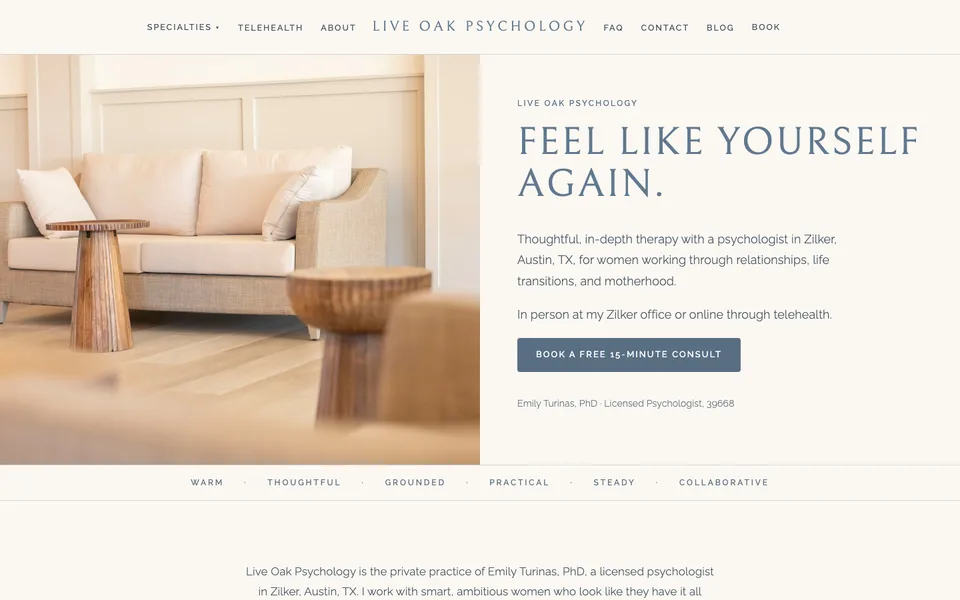
My own practice site, Live Oak Psychology, built with Launch from the same questions you'll answer. More examples.

Launch

Every step done with you, and your website built and written for you

Launch walks you through this whole checklist for your state and license, in order, and drafts the writing: your website, written from your answers and set up for Google; your intake paperwork; and your Psychology Today and Google profiles. You review and approve everything. $149 founding price, one time$299, one time, with a 7-day refund.

  • Built by Dr. Emily Turinas, PhD, a licensed psychologist in private practice
  • 16 website designs, your colors, hosting included (you pay only for your domain)
  • No drip, no upsell: one price for the whole launch
Get Launch · $149 founding price$299Or start with the free checklist →

By state

Psychologists: your board in every state

Your board, continuing education, and renewal, from our board research. Open your state for its ad rules, business filings, paperwork rules, and the full checklist.

StateTitleBoardContinuing education
AlabamaPsychologistAlabama Board of Examiners in Psychology20 hours per year, in a credit year that runs October 1 to September 30.
AlaskaPsychologistAlaska Board of Psychologist and Psychological Associate Examiners40 hours every 2 years, with at least 3 in professional ethics.
ArizonaPsychologistArizona Board of Psychologist Examiners, 1740 W40 hours every license period.
ArkansasPsychologistArkansas Psychology Board (part of the Arkansas Department of Health)Earn 20 hours of CE in each annual renewal period, July 1 to June 30.
CaliforniaPsychologistBoard of Psychology (California Department of Consumer Affairs)36 hours of continuing professional development every 2 years.
ColoradoPsychologistColorado State Board of Psychologist Examiners, part of the Department of Regulatory Agencies (DORA), Division of Professions and Occupations40 professional development hours (PDH) every 2-year cycle.
ConnecticutPsychologistConnecticut Board of Examiners of Psychologists, which works within the Connecticut Department of Public Health (DPH)10 hours of CE in each 12-month registration period.
DelawarePsychologistDelaware Board of Examiners of Psychologists, Division of Professional Regulation, Delaware Department of State40 hours every 2 years, with at least 10 face to face or live webinar.
District of ColumbiaPsychologistDistrict of Columbia Board of Psychology, part of DC Health (Health Regulation and Licensing Administration)Earn 30 hours every 2-year renewal period.
FloridaPsychologistFlorida Board of Psychology (under the Florida Department of Health, Division of Medical Quality Assurance)40 hours every 2-year renewal.
GeorgiaPsychologistGeorgia State Board of Examiners of Psychologists (part of the Georgia Secretary of State, Professional Licensing Boards Division)40 CE credits every 2 years.
HawaiiPsychologistHawaii Board of Psychology, within the Department of Commerce and Consumer Affairs (DCCA), Professional and Vocational Licensing DivisionEarn 18 credit hours every 2-year licensing biennium.
IdahoPsychologistIdaho State Board of Psychologist Examiners, within the Division of Occupational and Professional Licenses (DOPL)30 hours every 2 calendar years, including at least 4 hours in Laws and Ethics.
IllinoisPsychologistIllinois Department of Financial and Professional Regulation (IDFPR), Division of Professional Regulation, with the Clinical Psychologists Licensing and Disciplinary Board24 hours per 24-month renewal period, with at least 3 on the ethical practice of clinical psychology.
IndianaPsychologistIndiana State Psychology Board, staffed by the Indiana Professional Licensing Agency (PLA)CE is required only if you hold the HSPP endorsement.
IowaPsychologistIowa Board of Behavioral Health Professionals, part of the Iowa Department of Inspections, Appeals, and Licensing (DIAL)40 hours every 2 years, including 6 hours on law, ethics or risk management.
KansasPsychologistKansas Behavioral Sciences Regulatory Board (BSRB), K.A.R50 hours every 2 years, with 3 in ethics and 3 in diagnosis and treatment.
KentuckyPsychologistKentucky Board of Examiners of Psychology (201 KAR Chapter 26, KRS Chapter 319)Complete 39 hours every 3 years.
LouisianaPsychologistLouisiana State Board of Examiners of Psychologists, LAC Title 46, Part LXIII, Subpart 1 (Chapters 1 to 21), under LaComplete 30 hours of CE every two years.
MainePsychologistMaine State Board of Examiners of Psychologists40 hours every 2 years, with at least 3 in ethics.
MarylandPsychologistMaryland State Board of Examiners of Psychologists, Maryland Department of Health (COMAR Title 10, Subtitle 36; Health Occupations Article, Title 18)Complete 40 CE hours every 2 years.
MassachusettsPsychologistBoard of Registration of Psychologists (251 CMR), Division of Occupational Licensure20 hours every 2 years.
MichiganPsychologistMichigan Board of Psychology (LARA, Bureau of Professional Licensing)Earn 30 hours in the 2 years before renewal.
MinnesotaPsychologistMinnesota Board of PsychologyComplete 40 board-approved CE hours in each 2-year renewal period.
MississippiPsychologistMississippi Board of Psychology (Title 30, Part 3201, Rules and Regulations)Complete 20 hours of continuing education every 2 years.
MissouriPsychologistMissouri State Committee of Psychologists, Division of Professional Registration, Department of Commerce and Insurance (20 CSR 2235, RSMo 337.010 to 337.090)Complete 40 hours of CE in the 2 years before each renewal.
MontanaPsychologistMontana Board of Psychologists, Department of Labor and Industry40 hours every 2 years, including 2 hours of ethics and 1 hour of suicide prevention.
NebraskaPsychologistNebraska Board of Psychology, which advises the DHHS Division of Public Health Licensure Unit24 hours every 2 years, with at least 3 in ethics.
NevadaPsychologistNevada Board of Psychological Examiners (NRS Chapter 641, NAC Chapter 641)Complete 30 hours of CE every 2 years.
New HampshirePsychologistNew Hampshire Board of Psychologists, part of the Office of Professional Licensure and Certification (OPLC)Complete 40 approved CE hours in each 2-year license term.
New JerseyPsychologistNew Jersey State Board of Psychological Examiners, Division of Consumer AffairsComplete 40 CE credits every 2 years.
New MexicoPsychologistNew Mexico Regulation and Licensing Department, Board of Psychologist Examiners (16.22 NMAC, Professional Psychologist Act, NMSA 61-9)40 hours every 2 years.
New YorkPsychologistNew York State Board for Psychology, NYS Education Department Office of the Professions (Education Law Article 153; Regents Rules Part 29; Commissioner's Regulations Part 72)36 hours of Department-approved CE every 3-year registration period.
North CarolinaPsychologistNorth Carolina Psychology Board24 hours every 2-year renewal period, with certificates submitted online through CE Broker before you renew.
North DakotaPsychologistNorth Dakota State Board of Psychologist Examiners40 credits every 2 years, with at least 3 in ethics, law or jurisprudence.
OhioPsychologistState Board of Psychology of Ohio23 hours every 2 years, finished by August 31 of each even-numbered year.
OklahomaPsychologistOklahoma State Board of Examiners of Psychologists, OAC Title 575 (Chapter 10, Licensure of Psychologists), under the Psychologists Licensing Act, 59 O.SComplete 20 hours of CE every calendar year, including 3 hours of ethics, law or practice standards.
OregonPsychologistOregon Board of Psychology (OAR chapter 858)40 credits every 2 years.
PennsylvaniaPsychologistPA State Board of PsychologyEarn 30 hours every 2-year renewal.
Rhode IslandPsychologistRhode Island Department of Health, Board of PsychologyComplete 24 CE credits every 2 years, relevant to psychology.
South CarolinaPsychologistSouth Carolina Board of Examiners in Psychology24 credits every 2 years.
South DakotaPsychologistSouth Dakota Board of Examiners of Psychologists (SDCL chapter 36-27A; ARSD article 20:60)15 hours every year, with no required topics that we found.
TennesseePsychologistTennessee Board of Examiners in Psychology, Tennessee Department of HealthComplete 40 hours every 2 years.
TexasLicensed PsychologistTexas State Board of Examiners of Psychologists, under the Behavioral Health Executive Council (BHEC)40 hours every 2 years, reported in CE Broker.
UtahPsychologistUtah Division of Professional Licensing (DOPL), Behavioral Health Board (Psychologist Licensing Act, Utah Code 58-61, rule chapter R156-61)48 hours every 2 years, with at least 6 in ethics and law.
VermontPsychologistVermont Board of Psychological Examiners, within the Secretary of State's Office of Professional Regulation (OPR)Complete 60 hours of CE every 2 years, including 6 hours of ethics and 1 hour on systematic oppression and anti-oppressive practice.
VirginiaPsychologistVirginia Board of Psychology (18VAC125-20), Department of Health Professions14 board-approved hours every year.
WashingtonPsychologistWashington State Department of Health (DOH) with the Examining Board of PsychologyComplete 60 hours of CE every 3 years.
West VirginiaPsychologistWest Virginia Board of Examiners of PsychologistsComplete 20 hours of board-approved continuing education every 2 years.
WisconsinPsychologistWisconsin Psychology Examining Board, part of the Department of Safety and Professional Services (DSPS)40 hours every 2 years, with at least 6 in ethics, risk management or jurisprudence.
WyomingPsychologistWyoming Board of PsychologyComplete 30 CE hours, earned within the 48 months before your renewal date.

For psychologists

What's different when you open as a psychologist

Your title

Only licensed psychologists may call themselves psychologists. Check how your board wants your degree and license shown in ads.

Medicare

Yes. Psychologists can enroll in Medicare and bill it directly. Staying private pay? You can opt out instead: an affidavit to your Medicare contractor and a private contract with each Medicare client, for 2-year periods that renew automatically.

Seeing clients in other states

PSYPACT lets psychologists in member states see clients by telehealth in other member states, with ASPPB's E.Passport and an APIT. More than 40 states have joined; check that both your state and your client's state are active members.

NPI taxonomy code

103T00000X (Psychologist) or 103TC0700X (Clinical Psychologist)

Professional association

APA (American Psychological Association) and your state psychological association. Membership often includes ethics consultation and practice resources.

Testing

Psychological testing is a service only psychologists can usually offer. It's billed with CPT 96130/96131 (evaluation) and 96136/96137 (administration and scoring). Budget for test kits and scoring, and check your malpractice policy covers it.

Frequently asked questions

Can a psychologist have a private practice?

Yes. A fully licensed Licensed Psychologist can open a solo private practice in the states where they're licensed. Associates and other pre-licensed clinicians generally must practice under a supervisor; check your board's rules.

How much does it cost to start a psychology practice?

A lean, telehealth-only practice usually costs about $1,000 to $3,000 in the first year. Malpractice insurance and an EHR are the main required costs; an office adds rent.

Do I need a PLLC as a psychologist?

Not always. Many psychologists form a PLLC for liability separation, and some states require a professional entity for licensed professionals. A sole proprietorship needs no state filing. Check your state's rules.

Can a psychologist bill Medicare?

Yes. Psychologists can enroll in Medicare and bill it directly.

Can a psychologist see clients in another state?

PSYPACT lets psychologists in member states see clients by telehealth in other member states, with ASPPB's E.Passport and an APIT. More than 40 states have joined; check that both your state and your client's state are active members.

What NPI taxonomy code do psychologists use?

103T00000X (Psychologist) or 103TC0700X (Clinical Psychologist)

Is there a program that helps psychologists start a private practice and build a website?

Yes. Well Launched's Launch program walks you through each step for your state and license and builds and writes your website from your answers. It's $149 founding price, one time$299, one time, made by a licensed psychologist. You can also start with the free checklist.

Sources

Checked November 9, 2026. Board details come from official board, statute, and state filing sites. If something has changed, email [email protected] and we'll update it.

Starting a private practice with another license

Or by state: all 50 states and DC.